You’re chatting with someone online. Everything feels smooth. Then you suddenly see a message like: “ION even care anymore.” And you stop. 🤔
Is it science? Is it chemistry? Or is it slang?
If you’ve ever wondered what is the ION meaning in text, you’re in the right place. This slang term is extremely common in modern texting, especially among younger users, and yet it confuses a lot of people at first glance.
In this complete guide, we’ll explain ION meaning in text in simple words, show real-life examples, break down its origin, and help you understand exactly when and how to use it — without sounding awkward or confused.
ION Meaning in Text (Quick & Clear Answer) ⚡
The most common meaning of ION in text is:
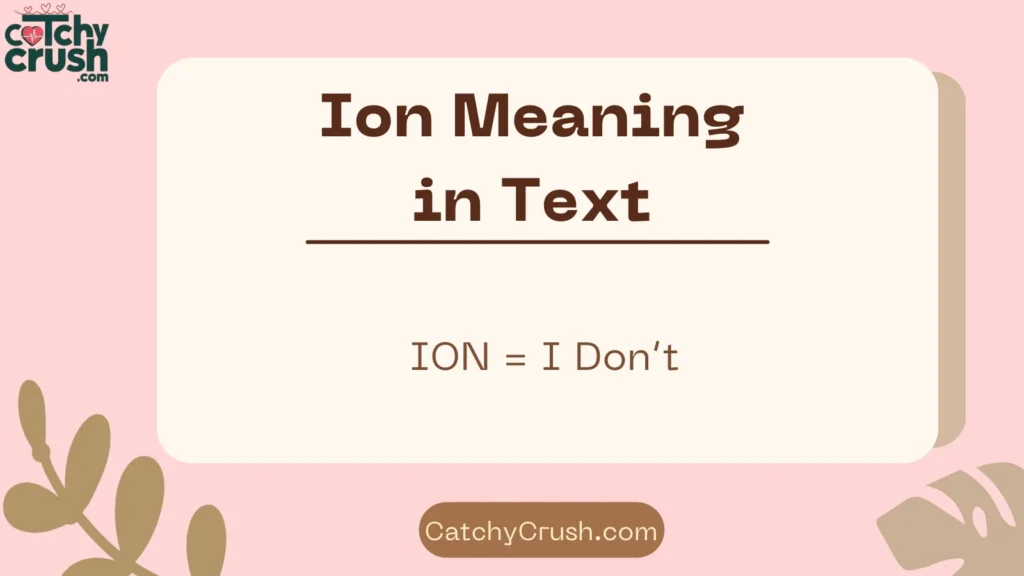
ION = I Don’t
Yes, it’s that simple.
ION is a phonetic slang abbreviation. When spoken out loud, “I don’t” often sounds like “ion,” especially in fast or casual speech. Texting simply copied the sound into written form.
Example:
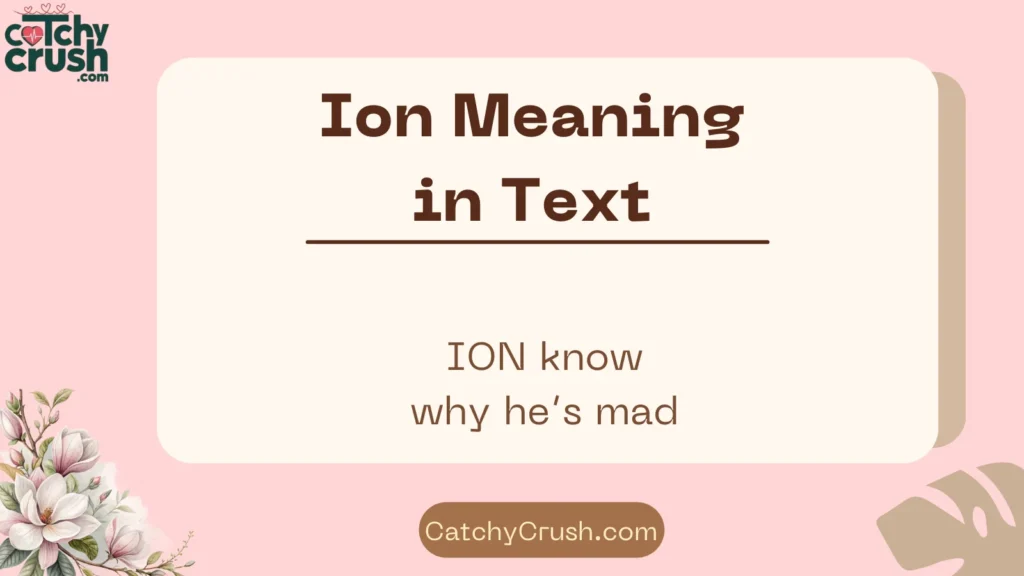
“ION know why he’s mad.”
This sentence means:
“I don’t know why he’s mad.”
Why Do People Use ION in Texting? 🤷♂️
To fully understand ion meaning in text, you need to understand how texting culture works.
People want:
- ✅ Faster typing
- ✅ Shorter messages
- ✅ A casual, relaxed tone
- ✅ Slang that feels natural
ION checks all these boxes. It’s quick, expressive, and feels more conversational than typing “I don’t” every time.
Origin of ION Slang Meaning 🕰️
The ION slang meaning comes from spoken language rather than grammar rules.
In everyday speech, many English speakers naturally pronounce:
- “I don’t” → “ion”
This pronunciation became popular in:
- Casual conversations
- Urban slang culture
- Online chats and social media
Eventually, people began spelling the sound exactly how it’s spoken — and ION was born.
ION Meaning in Text vs Dictionary Meaning ⚠️
This is where confusion often happens.
In textbooks and science, an ion is a charged particle. In texting slang, ION has nothing to do with science.
| Context | Meaning of ION |
|---|---|
| Texting / Slang | I Don’t |
| Science / Chemistry | Charged atom or molecule |
Always rely on context. In messages and chats, it almost always means “I don’t.”
How ION Is Used in Everyday Texting 💬
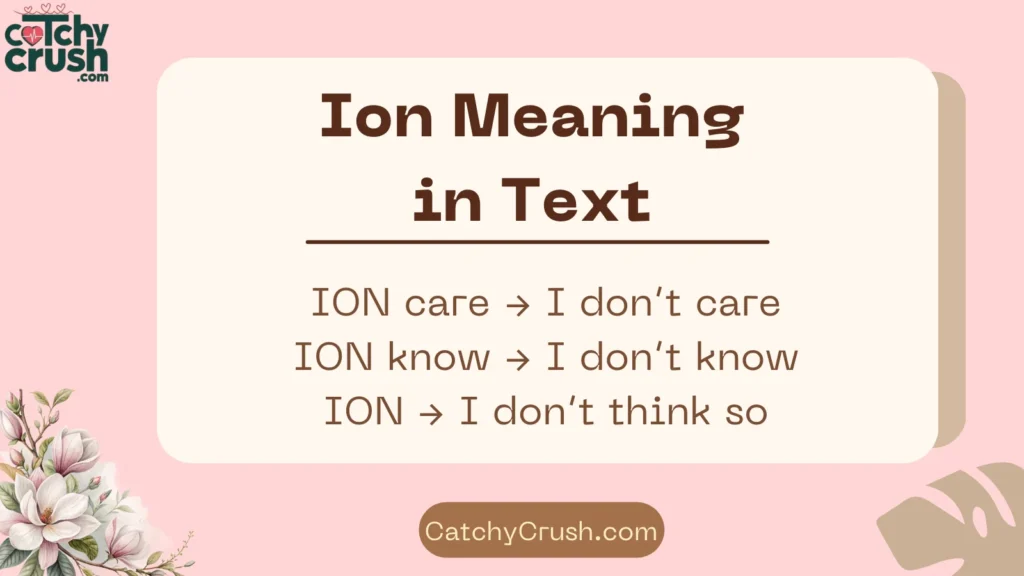
Here are common sentence structures where ION appears naturally:
- ION care → I don’t care
- ION know → I don’t know
- ION think so → I don’t think so
- ION want that → I don’t want that
Example messages:
“ION feel like going out today.”
“ION see the problem.”
ION Meaning in Casual Conversations 🧠
ION is mostly used in:
- Friend-to-friend chats
- Group messages
- Social media comments
- Informal DMs
It creates a relaxed tone and often reflects emotion, mood, or attitude.
Example:
“ION even care anymore 😒”
This shows emotional distance or frustration without explaining much.
Is ION Grammatically Correct? ✍️
Short answer: No — but that’s the point.
ION is slang. It’s not meant for:
- ❌ School essays
- ❌ Work emails
- ❌ Professional communication
It is perfectly fine for:
- ✅ Text messages
- ✅ Casual online chats
- ✅ Informal writing
Slang breaks grammar rules on purpose to sound natural.
ION vs IDK vs IDC (Key Differences) 🔍
Let’s compare ION with similar texting abbreviations:
| Slang | Full Meaning | Usage |
|---|---|---|
| ION | I Don’t | Sentence starter |
| IDK | I Don’t Know | Specific response |
| IDC | I Don’t Care | Emotional response |
ION is more flexible because it works with many verbs.
ION Meaning on Social Media 📱
ION appears frequently in:
- Comments
- Captions
- Replies
Example:
“ION understand why people do this.”
It keeps posts short, expressive, and relatable — perfect for fast-scrolling platforms.
Can ION Be Misunderstood? 😬
Yes, especially by:
- Older readers
- Non-native English speakers
- People unfamiliar with slang
Without context, someone might think you’re referring to science or making a typo.
If clarity matters, use “I don’t” instead.
When Should You Avoid Using ION? 🚫
Avoid ION in:
- Professional conversations
- Formal writing
- Serious discussions
Using slang in the wrong setting can make you appear careless or unclear.
How to Reply When Someone Uses ION 🤝
You don’t need to correct them. Just reply naturally.
Example:
Them: “ION think that’s a good idea.” You: “Yeah, I get what you mean.”
Matching tone helps conversations flow smoothly.
Common Misconceptions About ION ❌
- ❌ It does NOT mean ion (science)
- ❌ It is NOT formal English
- ✅ It DOES mean “I don’t” in text
Once you know this, ION becomes easy to recognize.
FAQs About ION Meaning in Text ❓
What does ION mean in texting?
ION means I don’t. It’s a slang abbreviation used in casual messages.
Is ION rude?
No. It’s informal but not offensive. Tone depends on the message.
Is ION commonly used?
Yes, especially among younger users and on social media.
Can I use ION in professional chats?
No. It’s best kept for casual conversations only.
Final Thoughts:
Now you clearly understand ion meaning in text. It’s simple. It’s casual. And it’s all about how people really speak.
Language online evolves fast. Knowing modern slang like ION helps you stay connected, confident, and in sync with today’s digital conversations.
👉 Want to understand more texting slang and modern abbreviations? Keep exploring related posts and level up your chat game 🚀

Hi, I’m Pollard, the voice behind CatchyCrush. I’m passionate about uncovering the hidden meanings behind the words we use every day. From texting slang to trending phrases, I write in-depth articles that help readers understand language in a fun, easy-to-grasp way. At CatchyCrush, my goal is to make every word clear, catchy, and memorable. When I’m not writing, you can find me exploring new ways words connect people online.